My Grandfather was foreman at a paper mill in the town where I
lived. At some point the mill had retired a small machine which
looked and acted just like a lathe. It was actually a Dexter Valve
Re-seating Machine made by The Leavitt Machine Co. in Orange,
MA. >>>>>>>>>>>
My Grandfather took it home and "put it to good use". For me,
sneaking into his garage shop left me memories of huge clumps of
long steel curlies and the heavy perfume of machine oil.
When he passed away it was kept in storage across the street at
his machinist neighbor's house. Here it stayed for about 10 years.
He stored it for his son - my uncle - who lived in Hawaii and planned
to move out to New England to retire and work on guns (his favorite
hobby). As time went on, though, he decided to stay put. When he
heard I was knee-deep in the clock world he wrote me to take the
lathe and "put it to good use" (he too sadly passed away recently).
So I rescued it from storage, completely disassembled it and
soaked all the parts in kerosene, then re-oiled everything and set it
up on a small bench in my basement shop, intending to put it to
good use.
From a machining standpoint I can't really see why this isn't
considered a lathe other than the compound slide has less than a
1-inch travel - and there's the rub: you can do a lot of things with
this handicap, but there are a lot of things you can't do. To make it
unfriendlier, the headstock does not have a hollow spindle; the
threaded end only accepts the 3-jaw chuck that came with it.
Finally, since it was not technically a lathe there were no
accessories available to outfit it as a proper shop lathe.
Because I already had a Schaublin lathe and plenty of accessories
I felt that designing and making accessories to fit the Leavitt would
not be in my best interest of time or money. As much as I loved it,
Craigslist began to cross my mind.........
A few months ago a clockmaker friend of mine was visiting my shop.
I was telling him about my issues with the Leavitt and how I was
thinking of getting rid of it. His wise words still ring: "don't ever get
rid of anything like that...you'll always find a use for it".
I spend a lot of time at my basement desk; I like to do all of my
"dirty" work there - pivot polishing, cleaning, re-bushing, laying out
& making new parts, etc. - and using my upstairs desk for final
assembly in a clean environment. Sitting at the basement desk,
though, I stare directly at the Leavitt and while I work I'm always
stopping and looking at it, wondering what I could do to make it a
useful part of my shop.
Now, I love my Wheelcutter, but I wanted a simpler method of
cutting gears without the time consuming set-up.
I acquired a Logan Lathe awhile back which gives me the ability to
cut threads (which the Schaublin unfortunately does not). Although
I love the Logan, the best part of the purchase was the 10 billion
accessories and STUFF that came with it. Well, one day I was
sifting through the stuff and I pulled out a 6" diameter steel
faceplate with a 1/2" thread. I ran downstairs and pulled the back
gears off of the Leavitt and found that the faceplate threaded on
perfectly. From there I made up a threaded arbor and chucked the
faceplate up in the dividing head, mounting it on my milling
machine. The direct index plate was soon complete with divisions of
96, 84, 72, etc. and my Leavitt "Dexter Valve Re-Seating Machine"
was beginning it's metamorphoses into my newest wheel cutting
engine>>>>>>>>>>>>>>>>>
More to come......................................
lived. At some point the mill had retired a small machine which
looked and acted just like a lathe. It was actually a Dexter Valve
Re-seating Machine made by The Leavitt Machine Co. in Orange,
MA. >>>>>>>>>>>
My Grandfather took it home and "put it to good use". For me,
sneaking into his garage shop left me memories of huge clumps of
long steel curlies and the heavy perfume of machine oil.
When he passed away it was kept in storage across the street at
his machinist neighbor's house. Here it stayed for about 10 years.
He stored it for his son - my uncle - who lived in Hawaii and planned
to move out to New England to retire and work on guns (his favorite
hobby). As time went on, though, he decided to stay put. When he
heard I was knee-deep in the clock world he wrote me to take the
lathe and "put it to good use" (he too sadly passed away recently).
So I rescued it from storage, completely disassembled it and
soaked all the parts in kerosene, then re-oiled everything and set it
up on a small bench in my basement shop, intending to put it to
good use.
From a machining standpoint I can't really see why this isn't
considered a lathe other than the compound slide has less than a
1-inch travel - and there's the rub: you can do a lot of things with
this handicap, but there are a lot of things you can't do. To make it
unfriendlier, the headstock does not have a hollow spindle; the
threaded end only accepts the 3-jaw chuck that came with it.
Finally, since it was not technically a lathe there were no
accessories available to outfit it as a proper shop lathe.
Because I already had a Schaublin lathe and plenty of accessories
I felt that designing and making accessories to fit the Leavitt would
not be in my best interest of time or money. As much as I loved it,
Craigslist began to cross my mind.........
A few months ago a clockmaker friend of mine was visiting my shop.
I was telling him about my issues with the Leavitt and how I was
thinking of getting rid of it. His wise words still ring: "don't ever get
rid of anything like that...you'll always find a use for it".
I spend a lot of time at my basement desk; I like to do all of my
"dirty" work there - pivot polishing, cleaning, re-bushing, laying out
& making new parts, etc. - and using my upstairs desk for final
assembly in a clean environment. Sitting at the basement desk,
though, I stare directly at the Leavitt and while I work I'm always
stopping and looking at it, wondering what I could do to make it a
useful part of my shop.
Now, I love my Wheelcutter, but I wanted a simpler method of
cutting gears without the time consuming set-up.
I acquired a Logan Lathe awhile back which gives me the ability to
cut threads (which the Schaublin unfortunately does not). Although
I love the Logan, the best part of the purchase was the 10 billion
accessories and STUFF that came with it. Well, one day I was
sifting through the stuff and I pulled out a 6" diameter steel
faceplate with a 1/2" thread. I ran downstairs and pulled the back
gears off of the Leavitt and found that the faceplate threaded on
perfectly. From there I made up a threaded arbor and chucked the
faceplate up in the dividing head, mounting it on my milling
machine. The direct index plate was soon complete with divisions of
96, 84, 72, etc. and my Leavitt "Dexter Valve Re-Seating Machine"
was beginning it's metamorphoses into my newest wheel cutting
engine>>>>>>>>>>>>>>>>>
More to come......................................
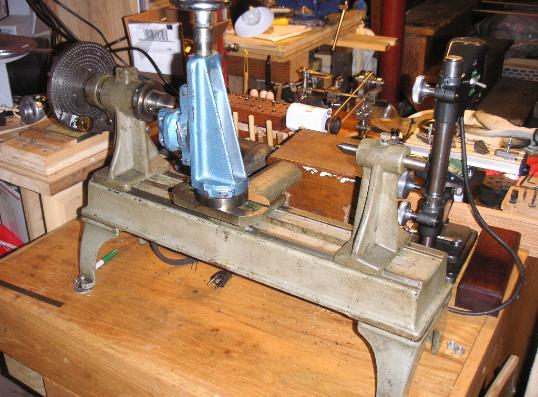
| The New Wheel Cutting Engine An Ongoing Saga |

| Direct Indexing Plate with Spring-Loaded Advance Pin |
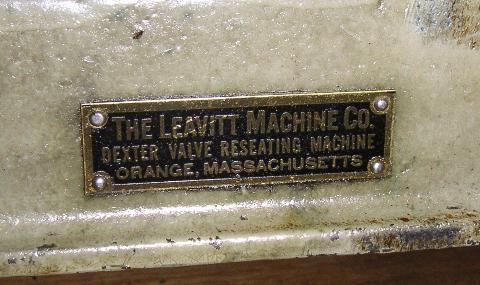
| I'm armed and ready if I ever need to re-seat a Dexter Valve |

