| Wheel and Pinion Cutter |
To make a clock one must have a way of forming the "teeth" on
the gears (wheels and pinions) that transfer power from the
motive force appropriately and as efficiently as possible>>>>>
An excellent book on the subject is F. Malcolm Wild's Wheel
and Pinion Cutting in Horology. Like most horological books,
you will not find it at your local Barnes and Nobles, but it is
plentiful online.
To cut the teeth to make gears one needs:
1) A method of firmly holding the blank to be cut
2) A method of indexing the blank (ie. if the wheel will have 40
teeth you will need to be able to turn the blank 1/40th of it's
circumference after each cut.
3) A cutter and a method of holding the cutter
4) A method of turning the cutter at a high enough speed and
torque to be able to smoothly cut the blank.
5) Ability to adjust the X,Y and Z axis.
Things that are nice to have:
1) Ability to vary the speed of the cutter
2) A safe set-up that does not involve any part of your body or
clothes within the machine's realm. This actually should be
mandatory....
3) Commercial multi-tooth pinion cutters, as single-toothed
flycutters will not hold up to steel.
4) A completely single purpose wheelcutting station, so you
don't have to tie up your lathe or milling machine.
5) A Lever Feed, or better yet, a CNC set-up.
6) A built-in coffee maker. Though I have yet to see one......
7) Lots of money. To, instead, buy a really nice one with an
assortment of cutters.
the gears (wheels and pinions) that transfer power from the
motive force appropriately and as efficiently as possible>>>>>
An excellent book on the subject is F. Malcolm Wild's Wheel
and Pinion Cutting in Horology. Like most horological books,
you will not find it at your local Barnes and Nobles, but it is
plentiful online.
To cut the teeth to make gears one needs:
1) A method of firmly holding the blank to be cut
2) A method of indexing the blank (ie. if the wheel will have 40
teeth you will need to be able to turn the blank 1/40th of it's
circumference after each cut.
3) A cutter and a method of holding the cutter
4) A method of turning the cutter at a high enough speed and
torque to be able to smoothly cut the blank.
5) Ability to adjust the X,Y and Z axis.
Things that are nice to have:
1) Ability to vary the speed of the cutter
2) A safe set-up that does not involve any part of your body or
clothes within the machine's realm. This actually should be
mandatory....
3) Commercial multi-tooth pinion cutters, as single-toothed
flycutters will not hold up to steel.
4) A completely single purpose wheelcutting station, so you
don't have to tie up your lathe or milling machine.
5) A Lever Feed, or better yet, a CNC set-up.
6) A built-in coffee maker. Though I have yet to see one......
7) Lots of money. To, instead, buy a really nice one with an
assortment of cutters.
I've cut gears on my milling machine before and it's a very
suitable arrangement. But I hate either tying up a machine that
gets used alot, or, having to knock down and set up a whole
wheelcutting system just to cut a 1-off wheel on a machine that
gets a lot of use in my shop, so I decided to make a separate,
single-purpose station to cut gears (see Things That Are Nice
To Have #4 above).
Items #1 and #2 (and most of #5) on the Needs list above are
easily satisfied by the "semi"-universal dividing head >>>>>>
that I have in the shop which is bolted to an XY milling table.
The threaded spindle end accepts a standard thread (1 1/2"-
8) 4-jaw chuck which grips a threaded arbor holding the blank.
The 4-jaw can be fiddled with (in conjunction with a dial
indicator) to reduce the run-out down to almost nothing.
suitable arrangement. But I hate either tying up a machine that
gets used alot, or, having to knock down and set up a whole
wheelcutting system just to cut a 1-off wheel on a machine that
gets a lot of use in my shop, so I decided to make a separate,
single-purpose station to cut gears (see Things That Are Nice
To Have #4 above).
Items #1 and #2 (and most of #5) on the Needs list above are
easily satisfied by the "semi"-universal dividing head >>>>>>
that I have in the shop which is bolted to an XY milling table.
The threaded spindle end accepts a standard thread (1 1/2"-
8) 4-jaw chuck which grips a threaded arbor holding the blank.
The 4-jaw can be fiddled with (in conjunction with a dial
indicator) to reduce the run-out down to almost nothing.

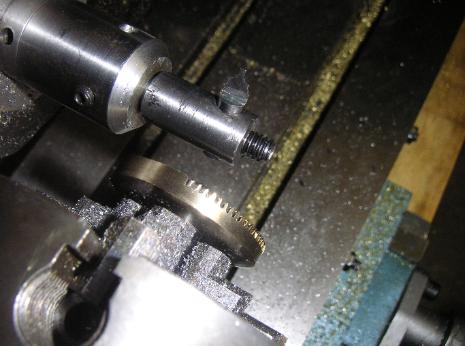
Homemade flycutter forming the teeth (very badly, I might add)
on a contrate wheel.
on a contrate wheel.
| My 'semi-universal' dividing head....proud and unconcerned that it is not a 'universal' dividing head... |
A note on "semi"-universal dividing heads, particularly for
clockmakers. They can divide a wheel into most any number
that a clockmaker would ever run into (there are some funky
numbers that you would need a "universal" head which
employs a separate set of gears to get you there). I was
surprised, however, to find out that, even with the wide
variety of index plates supplied with the head, I couldn't
divide a wheel into 96........96?!! You'd think it a common
number!! Well, after much head scratching and a couple
glasses of wine my head cleared and I figured out if I had an
index plate of only 12 (which most don't) the 40:1 worm ratio
would give me the 96 I needed. So I chucked up an index
plate on its own dividing head (it seems rather cannibalistic)
using a 3-jaw chuck (jaws turned out) and drill a 12-hole ring
around an unused portion of the index plate. And It works!!!!!!
clockmakers. They can divide a wheel into most any number
that a clockmaker would ever run into (there are some funky
numbers that you would need a "universal" head which
employs a separate set of gears to get you there). I was
surprised, however, to find out that, even with the wide
variety of index plates supplied with the head, I couldn't
divide a wheel into 96........96?!! You'd think it a common
number!! Well, after much head scratching and a couple
glasses of wine my head cleared and I figured out if I had an
index plate of only 12 (which most don't) the 40:1 worm ratio
would give me the 96 I needed. So I chucked up an index
plate on its own dividing head (it seems rather cannibalistic)
using a 3-jaw chuck (jaws turned out) and drill a 12-hole ring
around an unused portion of the index plate. And It works!!!!!!

